Structural Analysis of Planet Carrier Assemblies for a Transmission System
The problem
In high-torque-density power transmission systems, planetary gear sets are often selected because they combine compactness, efficiency, and the ability to distribute loads across multiple gears. In this context, the planet carrier is a critical component: it collects the loads generated by the planet gears, transfers them to the supports, and must maintain alignment accuracy and stiffness over time while meeting constraints related to weight, packaging, and manufacturability.
Operating conditions are not limited to transmitted torque alone: bearing reactions, moments induced by the kinematics, assembly effects, and tolerances also come into play, potentially introducing interference, contact pressures, and stress concentrations.
In heavily loaded assemblies of this kind, even small geometric discontinuities—such as reduced fillet radii, functional holes, or mating seats—can become critical areas, with the risk of triggering local plastic deformation or premature damage if they are not properly understood and addressed from the early stages of development.
The challenge
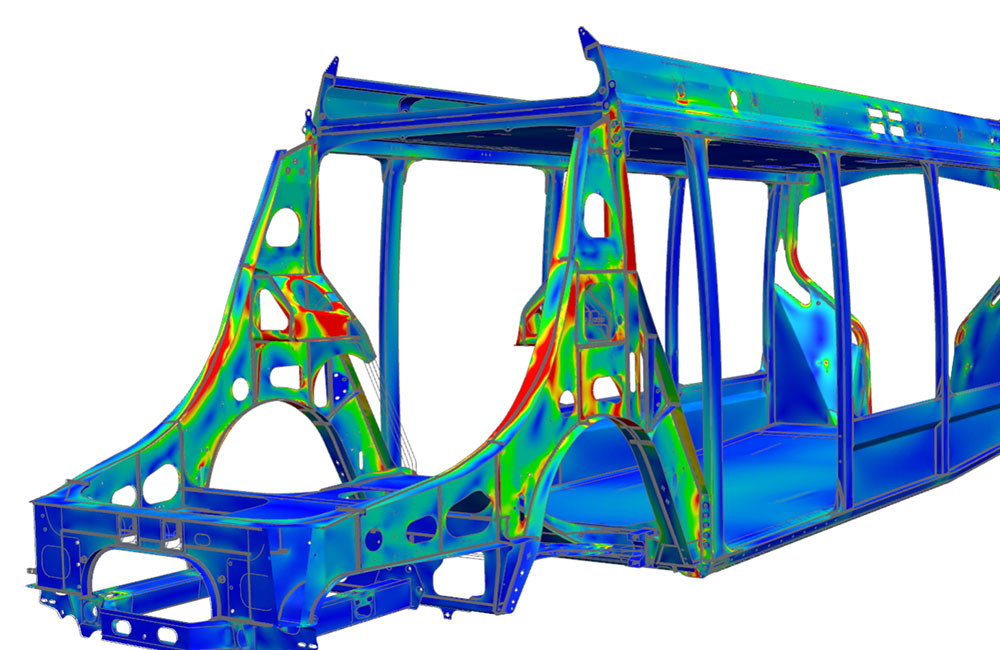
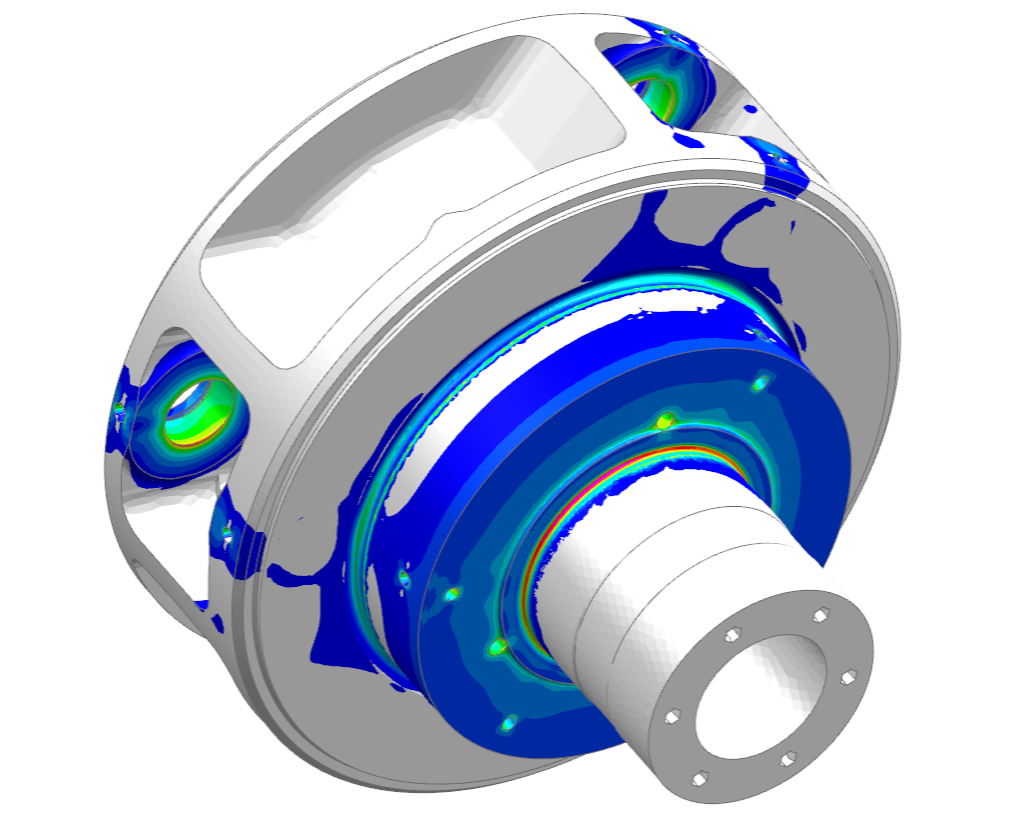
The engineering challenge was to accurately reproduce the complete load path within the assembly using high-fidelity finite element models that included realistic contacts, interference fits, and operating boundary conditions. This required solving nonlinear contact problems involving separation and re-contact, while distinguishing physically meaningful stress concentrations from purely numerical stress peaks through careful interpretation of both principal stresses and Von Mises stress distributions.
Our contribution
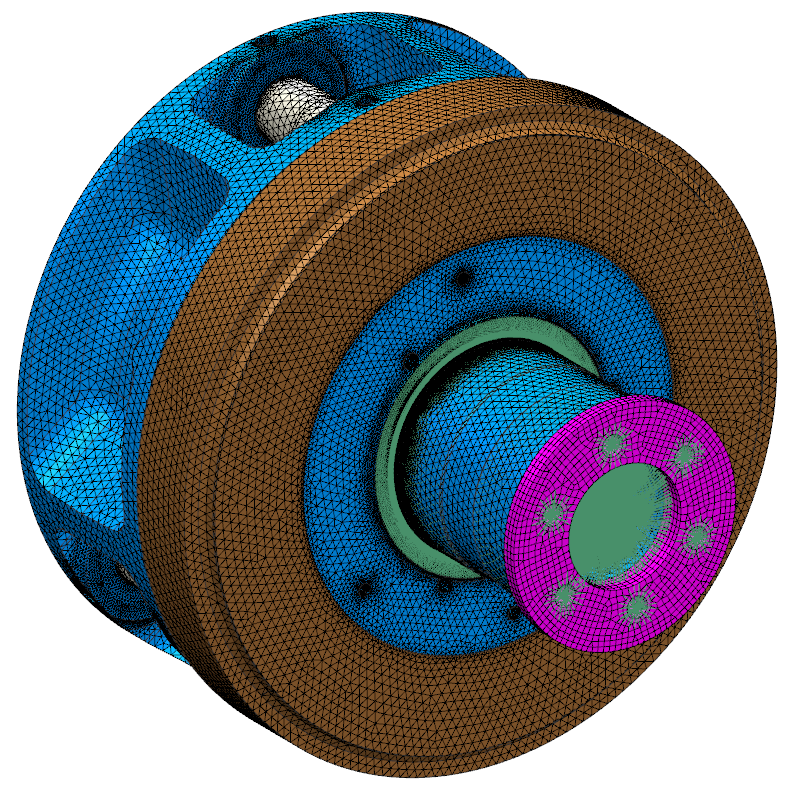
SmartCAE managed the complete simulation workflow, from preparing the finite element model directly from the CAD geometry to the engineering interpretation of the simulation results.
A detailed finite element model of the planet carrier assembly was developed, including all surrounding components required to accurately reproduce the real load path and the mechanical interactions within the transmission system. Contact interfaces and interference-fit assemblies were modelled to capture the effects of press-fit pins, bearing seats, and assembly-induced stresses.
The operational loading conditions were applied as fully balanced systems of forces and moments representative of the actual transmission operating conditions. Nonlinear contact analyses enabled realistic simulation of the interaction between mating components, accurately reproducing load transfer and local stiffness throughout the assembly.
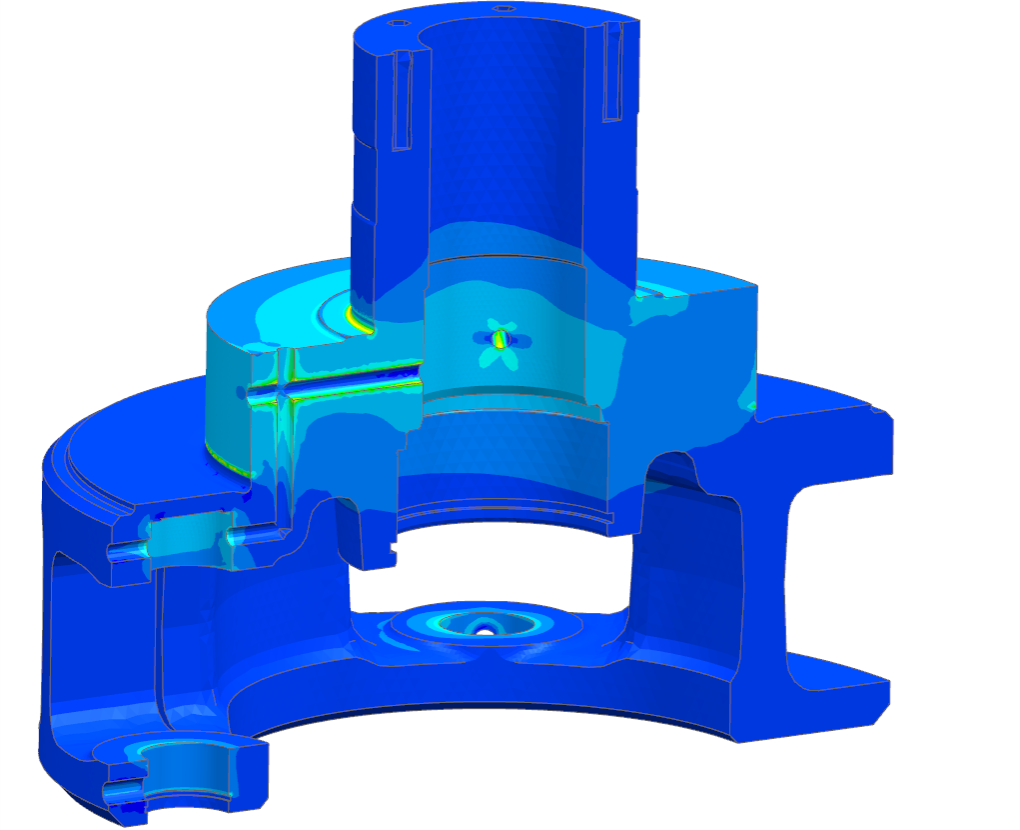
A detailed post-processing phase focused on identifying structurally significant stress concentrations around critical geometric discontinuities. Particular attention was given to distinguishing genuine structural hot spots from localized numerical singularities, providing clear engineering recommendations for improving local strength while preserving functionality, manufacturability, and assembly requirements.
The simulation also provided valuable insight into how loads propagate through the complete assembly and how contact conditions and interference fits influence stiffness, stress distribution, and overall structural performance.
Benefits for the client
The project provided the customer with a reliable structural assessment early in the product development process, enabling informed engineering decisions before prototype manufacturing.
By accurately identifying the truly critical regions of the component, design improvements could be focused where they delivered the greatest benefit, increasing confidence in both structural integrity and long-term reliability while avoiding unnecessary modifications elsewhere.
The comprehensive modelling methodology and fully documented simulation process also established a reusable engineering framework for future product developments. This facilitates efficient comparison between design variants, improves communication between engineering teams and manufacturing suppliers, and integrates simulation into the development process as a proactive design optimization tool rather than simply a final validation step.
As a result, the customer reduced development risk, minimized costly design iterations, and accelerated the path toward a robust, production-ready transmission assembly.
Gallery
Validate your product before you build it.
What if you could reduce your prototyping costs by up to 80%? Would you like to know how?
With computer simulation, we help you predict your product's performance under real operating conditions before it is manufactured. By identifying design issues early, you can minimize costly iterations, reduce development time, and launch reliable products right the first time.
Contact us todayFinite Element Structural Analysis FEA
Using finite element analysis FEA, we help companies identify potential product performance issues and implement design improvements long before physical prototypes are built. Learn more about our finite element analysis services.
Fatigue & Durability Analysis
Prevent structural failures caused by cyclic and dynamic loading through advanced fatigue simulations. We have the expertise and tools to accurately predict the fatigue life of products subjected to variable static loads and vibration-induced stresses.
CAE Analysis Software
Looking to integrate Virtual Prototyping into your engineering workflow?
Discover our range of CAE software solutions and expert mentoring services. Our specialists will help you select the solution that best fits your needs and ensure its successful integration into your product development process. Contact us today for a free technical assessment.
View all softwareSimcenter Femap Flow Solver
Femap Flow Solver provides state-of-the-art computational fluid dynamics (CFD) capabilities for fast and efficient fluid mechanics studies.
Simcenter 3D
Simcenter 3D is a modern CAE environment that enables rapid product performance evaluation by combining a powerful geometric modeller with an associative pre-processor and integrated multiphysics solvers. Simcenter 3D can perform simulations using geometry created in any CAD system.