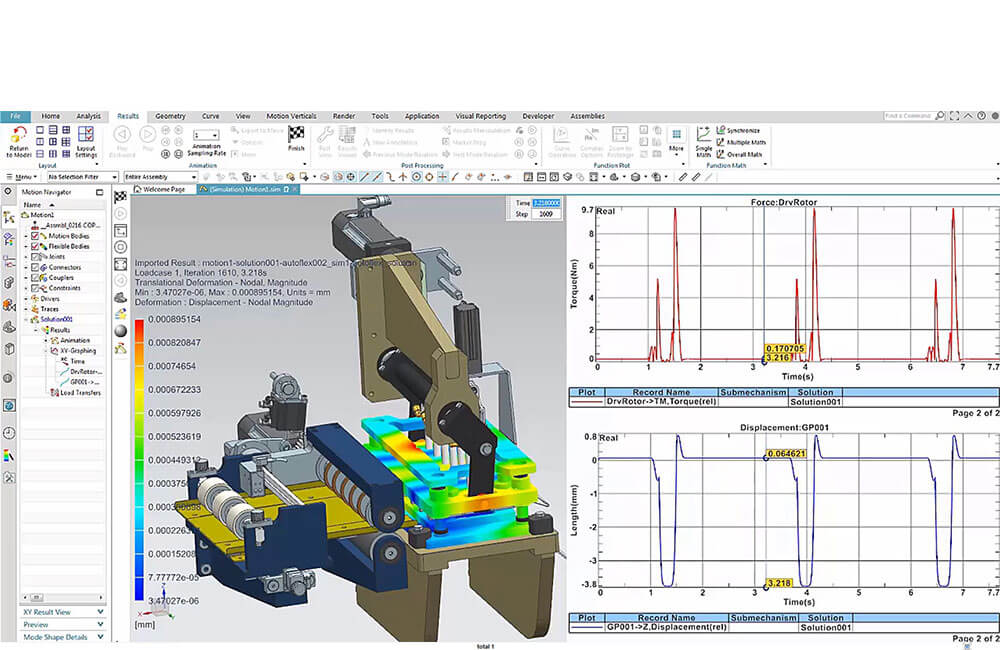
Multi-Body Dynamics Analysis
Discover how we can help you study the kinematic and dynamic performance of your product through our specialized multi-body dynamics analysis services.Download Brochure Request information
Multi-body analysis allows for the simulation of kinematic, dynamic, and structural behavior of mechanical assemblies composed of multiple parts in relative motion (linkages/mechanisms).
With multi-body analysis, we can derive the trajectories and velocities of mechanism members, as well as the forces exchanged between them over time.
If the mechanism is modeled using flexible bodies, it is possible to calculate mechanical stresses, their associated history, and their fatigue life.
In other words, we can create a true Digital Twin of the product and test it under actual operating conditions.
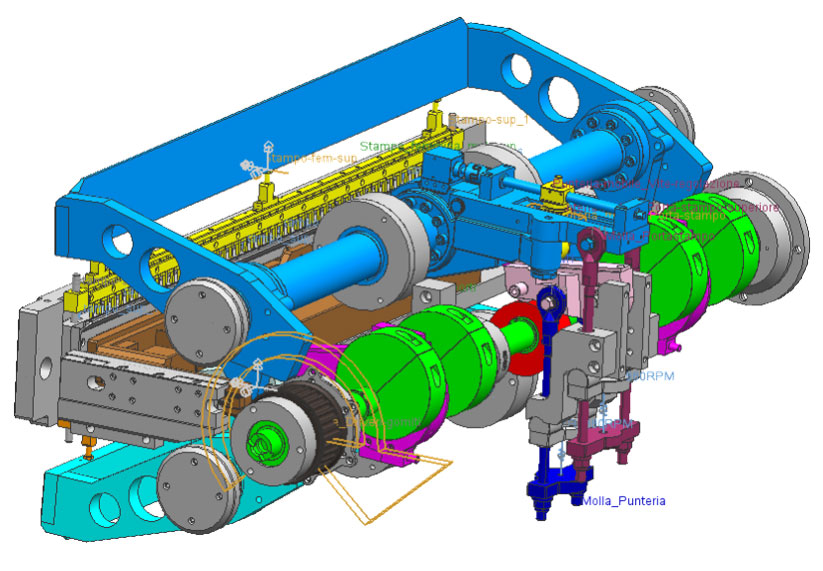
Creating the Digital Twin of the product
The Benefits of Multi-Body Dynamics Analysis
Multi-body dynamic simulations allow for the simultaneous consideration of body motion (Rigid Body models), elastic behavior (FEM models), and control logic (Co-simulation).
For these reasons, this technology enables us to create the Digital Twin of the product—a virtual replica that allows for testing under real-world operating conditions.
Through multi-body dynamics, we can replicate the same measurements obtained from physical testing by introducing virtual equivalents of devices such as accelerometers, strain gauges, and load cells.
It is clear how this approach significantly reduces prototyping costs while increasing confidence in product performance, leading to positive impacts on development time and costs.
Multi-Body Dynamics Analysis Services by SmartCAE
Over 20 years of engineering expertise at your service.
Using multi-body dynamics analysis, we can perform the following simulations:
This type of analysis determines the position, velocities, accelerations, and reaction forces within a kinematic chain during operation. In rigid body dynamics, it is possible to account for joint elasticity and apply time-varying loads. Using rigid body modeling, we can also simulate phenomena such as contact and impact between mechanism components.
When the stiffness of kinematic chain components can no longer be neglected, a flexible body representation is introduced using Finite Element Modeling (FEM) of the parts. In addition to the results of a rigid body analysis, this allows for the determination of the components’ deformation and stress fields.
The ability to simulate the actual operation of a mechanism via flexible multi-body analysis allows us to faithfully replicate the Duty Cycle of a fatigue test. This provides the stress and strain data needed for durability analysis. To learn more, visit our dedicated Fatigue and Durability Analysis page.
Validate your product before you build it.
What if you could reduce your prototyping costs by up to 80%? Would you like to know how?
With computer simulation, we help you predict your product's performance under real operating conditions before it is manufactured. Partner with us to eliminate design errors, optimize performance, and bring better products to market faster. Contact us today for a free consultation.
Contact us todayCAE Analysis Software
Looking to integrate Virtual Prototyping into your engineering workflow?
Discover our range of CAE software solutions and expert mentoring services. Our specialists will help you select the solution that best fits your needs and ensure its successful integration into your product development process. Contact us today for a free technical assessment.
View all softwareSimcenter 3D Motion
Simcenter 3D provides a complete and robust set of capabilities to support all aspects of advanced dynamic, static, and kinematic motion simulation.