The challenge
Developing a reliable digital twin of a complex system such as an industrial manipulator requires more than an accurate CAD model. While some aspects of system performance depend on the control strategy, others are governed by the mechanical characteristics of the structure, joints, and transmission system.
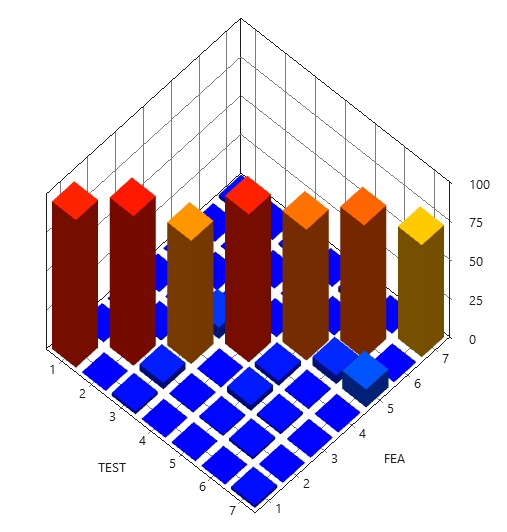
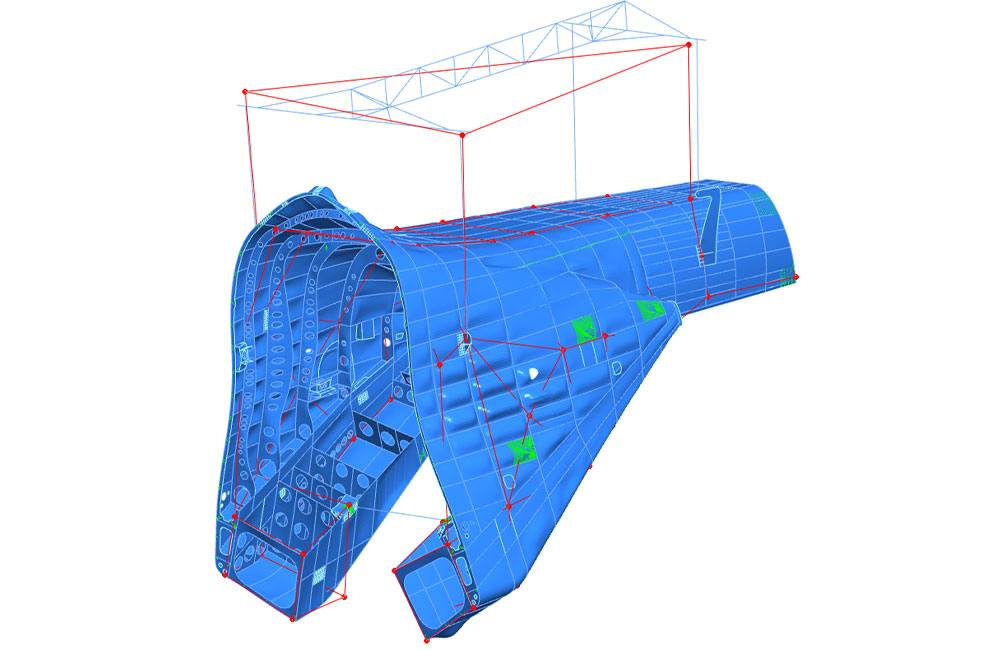
To accurately predict the robot’s behavior under operating conditions, the mechanical properties of the system must first be identified through experimental testing. This requires a comprehensive FEM–test correlation process, in which the numerical model is calibrated against experimental measurements, allowing the digital twin to faithfully reproduce the real dynamic response of the machine.
SmartCAE’s objective was to develop and validate a finite element model of the manipulator by accurately predicting its modal characteristics and correlating the numerical results with Experimental Modal Analysis measurements.
Our contribution
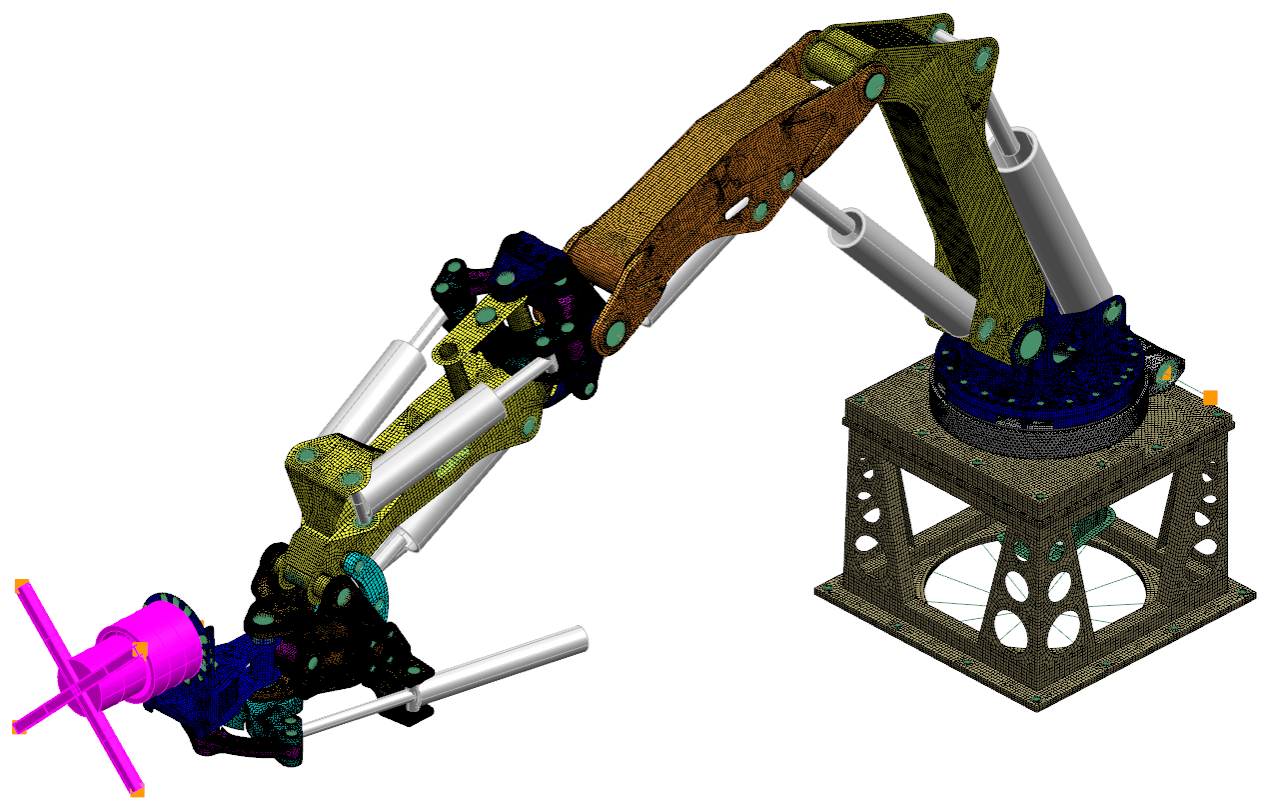
Starting from the robot’s 3D CAD geometry, SmartCAE developed a detailed finite element model, paying particular attention to the representation of the joints within the kinematic chain, which have a major influence on the dynamic behavior of the system.
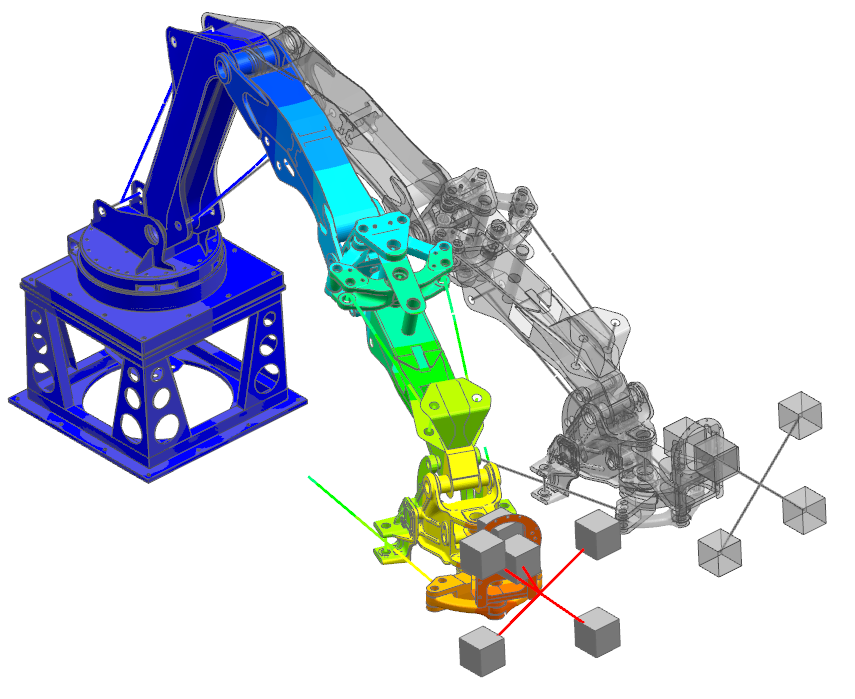
An extensive experimental modal testing campaign was then carried out to identify the robot’s natural frequencies and mode shapes. Measurements were performed with the manipulator positioned in multiple configurations to ensure reliable characterization across its operating workspace.
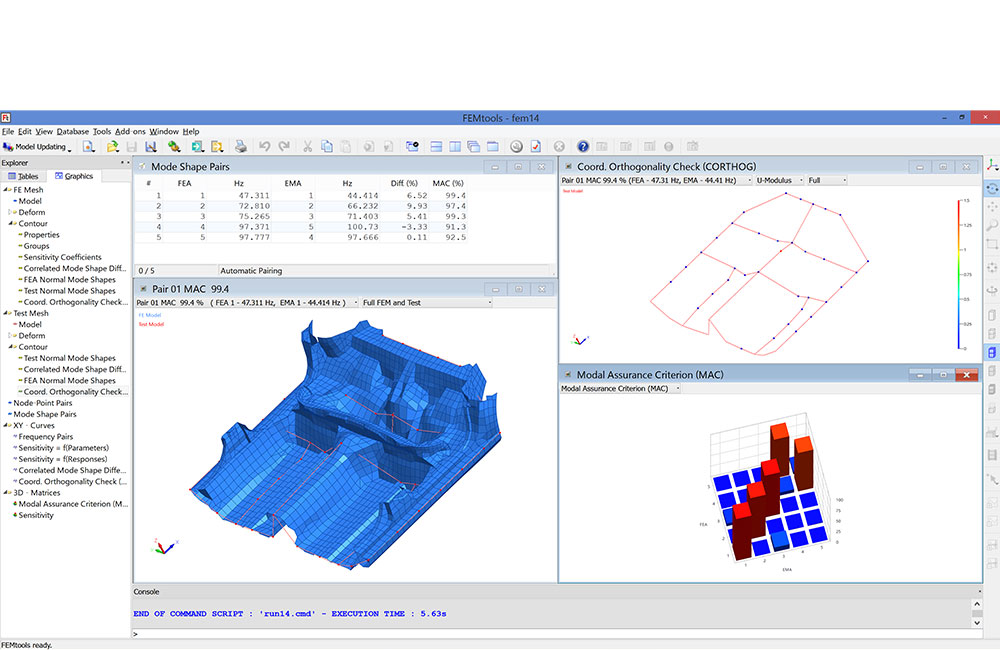
Finally, the numerical model was validated through a systematic FEM–test correlation and model updating process. Using specialized correlation software, joint stiffness values and other key model parameters were calibrated until an excellent agreement was achieved between the simulated and experimentally measured dynamic responses.
Benefits for the client
SmartCAE’s extensive experience in finite element modelling and structural dynamics enabled the customer to rely on a single engineering partner throughout the entire validation process—from numerical modelling and experimental testing to final model calibration.
The validated digital twin provided an accurate representation of the robot’s dynamic behavior, making it possible to identify the joints most susceptible to vibration and positioning errors. These insights supported targeted design improvements, increasing positioning accuracy, structural performance, and confidence in the robot’s behavior before production and deployment.
Gallery
Validate your product before you build it.
What if you could reduce your prototyping costs by up to 80%? Would you like to know how?
With computer simulation, we help you predict your product's performance under real operating conditions before it is manufactured. By identifying design issues early, you can minimize costly iterations, reduce development time, and launch reliable products right the first time.
Contact us todayDynamic Analysis & NVH
Dynamic and Noise, Vibration & Harshness analyses help predict product behavior and mechanical performance under vibration loading. Discover how we can help identify and solve vibration issues in your designs.
FEM-Test Correlation
One of the key challenges in simulation is ensuring that analytical models accurately represent real-world behavior. Model simplifications and uncertainties can lead to discrepancies during product validation testing. Our FEM-Test correlation and model calibration services help improve simulation accuracy and confidence.
CAE Analysis Software
Looking to integrate Virtual Prototyping into your engineering workflow?
Discover our range of CAE software solutions and expert mentoring services. Our specialists will help you select the solution that best fits your needs and ensure its successful integration into your product development process. Contact us today for a free technical assessment.
View all softwareFEMtools
FEMtools is a family of multifunctional CAE software solutions developed by Dynamic Design Solutions, providing analysis and scripting capabilities for correlation studies between finite element (FE) models and experimental measurements. FEMtools interfaces with the most widely used finite element analysis software and major experimental data formats.
Simcenter 3D
Simcenter 3D is a modern CAE environment that enables rapid product performance evaluation by combining a powerful geometric modeller with an associative pre-processor and integrated multiphysics solvers. Simcenter 3D can perform simulations using geometry created in any CAD system.